
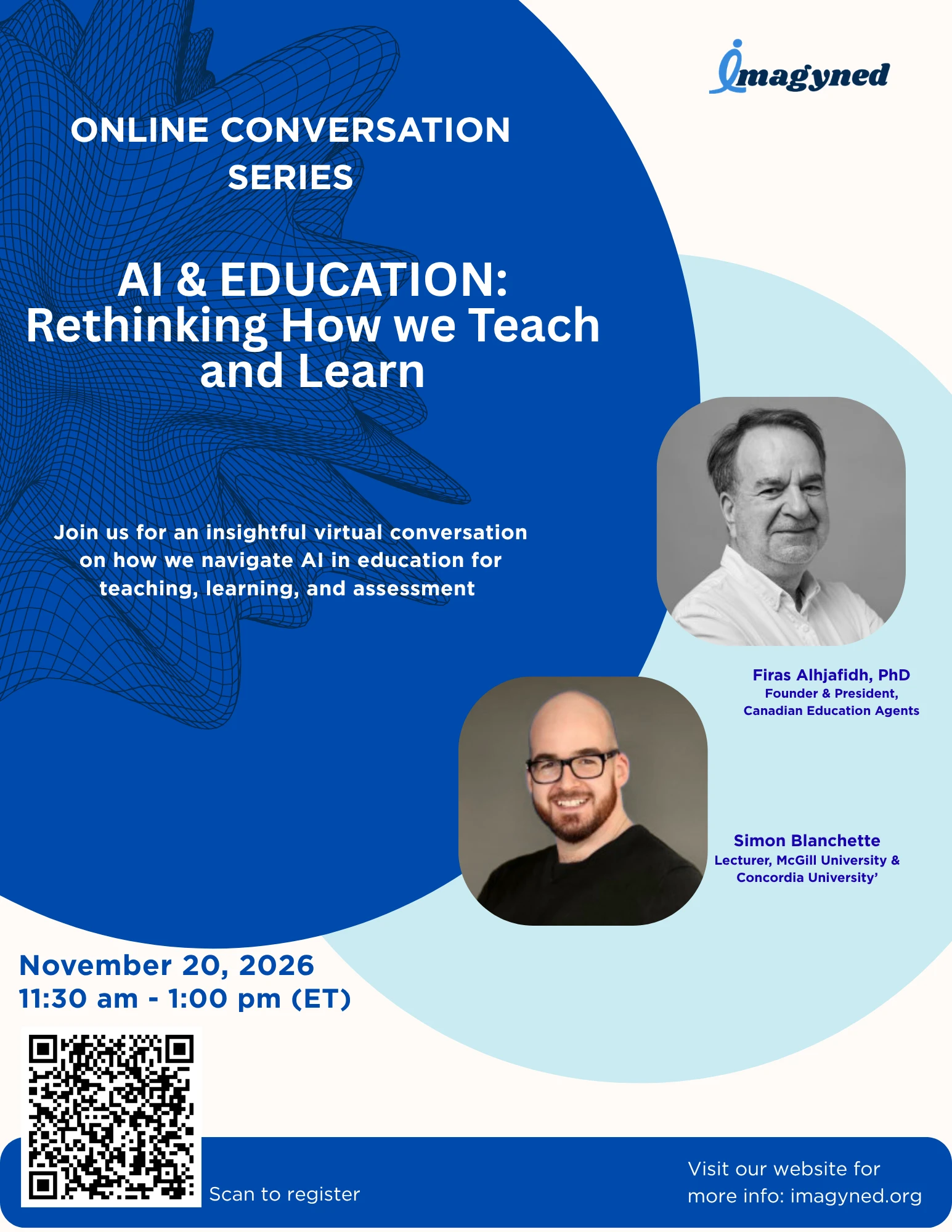
Online Conversation Series · 20 November 2026, 11:30am to 1:00pm (ET)
Artificial intelligence is developing at a remarkable pace. It represents one of the most significant technological innovations of our time, and at the same time, it raises concerns about learning, employment, ethics, and the future of education. Beneath both the excitement and anxiety lies a fundamental challenge: many people are still developing their understanding of what AI is, what it can do, where its limitations lie, and how to use it effectively.
For learners and educators, this knowledge gap matters. Decisions are increasingly being made about how students learn, which technologies they can use, how their work is assessed, and what skills they need for the future. Yet the tools themselves continue to evolve, often faster than educational policies, institutional practices, and people’s understanding can keep up. How can we navigate this changing landscape without either fearing AI or accepting its promises uncritically?
This session will explore how learners and educators can develop the knowledge, judgment, and confidence to engage with AI thoughtfully. Rather than focusing exclusively on particular tools or applications, the conversation will examine the fundamentals of AI, its practical implications for learning and teaching, and the critical skills needed to navigate an evolving technological landscape. The aim is to provide answers to this question: How can we understand AI well enough to make informed decisions about when, why, and how to use it in education?
Session objectives
By the end of the session, participants should be better equipped to:
- Understand the fundamentals: Explain in accessible terms what AI is, how generative AI works, and what large language models (LLMs) actually do.
- Distinguish capability from hype: Recognize what current AI tools can do well, where they struggle, and why their outputs should not automatically be treated as accurate or reliable.
- Evaluate AI’s role in learning: Consider when AI can support understanding and skill development and when its use may undermine the learning process.
- Develop critical AI literacy and adaptability: Identify practical ways to critically evaluate, verify, and responsibly use AI-generated information while developing the skills and mindset to adapt to evolving AI technologies and their implications for education and learning.
Speakers
- Firas Alhjafidh, PhD — Founder & President, Canadian Education Agents
- Simon Blanchette — Lecturer, McGill University & Concordia University